
HACOAJ FOOTBALL
Club Náutico Hacoaj, the only Jewish community club in an official AFA league, on its season, its youth, its women's team and the Hacoaj Camp Club Náutico Hacoaj, the only Jewish community club in an official AFA league, on its season, its youth, its women's team and the Hacoaj Camp
- 01 November, 2026
DREAM AND GOAL: TO BE A TOP-FLIGHT TEAM
By Club Náutico Hacoaj | Photos: Comunicación Hacoaj
Club Nautico Hacoaj is the only club from the Jewish community that competes in an official FIFA-affiliated football association. In 2026, for the third consecutive year, it played in the Argentine Football Association (AFA) Promotional Amateur Tournament—a category formerly known as Primera D.
The 2026 season once again demonstrated the team's growth. Hacoaj finished fourth in Group A with 26 points, tallying eight wins, two draws, and four losses. This campaign earned them a spot in the playoffs and brought them close to competing in the promotion play-off. In AFA tournaments, the club fielded teams in the First Division, six youth categories, and four children's divisions, in addition to receiving an invitation to participate in the veterans' category for players over 35 and over 45.
Beyond the results, the project upholds a premise central to Hacoaj’s identity: prioritizing players developed within its own youth ranks, while bringing in few new signings—and only for positions deemed strategic.
THE DREAM DOESN'T END THERE. NEITHER DOES THE GOAL
Hacoaj envisions a path of sustained growth that could one day lead the Club to compete in the top tiers of Argentine football and share the pitch with some of the country's most historic institutions. What might seem like a pipe dream is, for Hacoaj, a long-term project built on planning, infrastructure, and—above all—player development.
Work within the youth divisions is one of the club's main pillars. Season after season, the various age groups produce footballers of increasing quality and potential. Many go on to continue their careers at other clubs and in other leagues, whether because they reach the age limit for the Amateur Promotional Tournament or because they are recruited by other institutions.
Lukas Mamed, Teo Cohen, Tomás Rozic, Juan Kirchner, Bruno Solotar, Lorenzo Placente, Joaquín Rivas, Joaquín Regueira, Roque Chmea, Toto Oksengendler, Ariel Brunfman, Mateo Cordon, Martín Campanera, and Martín Lerner—among others—are examples of players taking Hacoaj’s colors to the wider world of football.
Far from representing a loss, these moves demonstrate the project's growth: players developed at Hacoaj finding new opportunities within competitive football.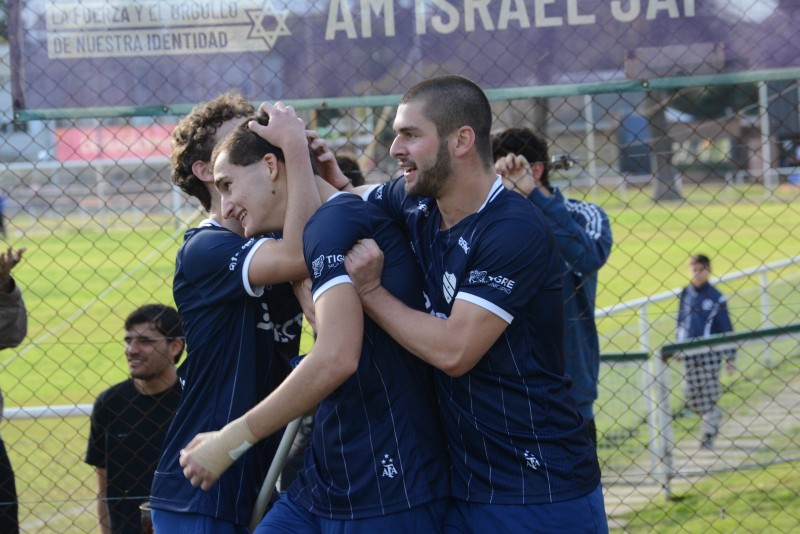
ACHIEVEMENTS THAT FUEL THE DREAM
In 2025, the 2013 age group was crowned champion of the César Luis Menotti Cup, organized by the AFA. This achievement made Hacoaj the first club from the Jewish community to win a youth championship organized by the Argentine Football Association.
Recognition of the work being done was also reflected in the AFA’s Alumni Awards, where Hacoaj received several honors: "Outstanding Institution for Visitor Hospitality," Sebastián Salmún as "Outstanding Executive," and Tomás Rozic as "Outstanding Player." These are sporting and institutional results that consolidate a process and reinforce the decision to continue growing.
INFRASTRUCTURE FOR CONTINUED GROWTH
Before joining official AFA competitions, Hacoaj’s men's football team played in various leagues and participated in the Federal B and Federal A tournaments, achieving notable results.
However, to advance toward new goals, athletic growth had to be matched by appropriate infrastructure.
With this vision, Hacoaj built the Shimon Peres Stadium at the Tigre Maliar site—a facility featuring a premium synthetic turf pitch, locker rooms, stands, and lighting. This investment, combined with the necessary institutional efforts, enabled the Club to begin competing in the AFA Promotional Amateur Tournament (formerly the historic Primera D) in 2024.
THE PROJECT TAKES ANOTHER STEP FORWARD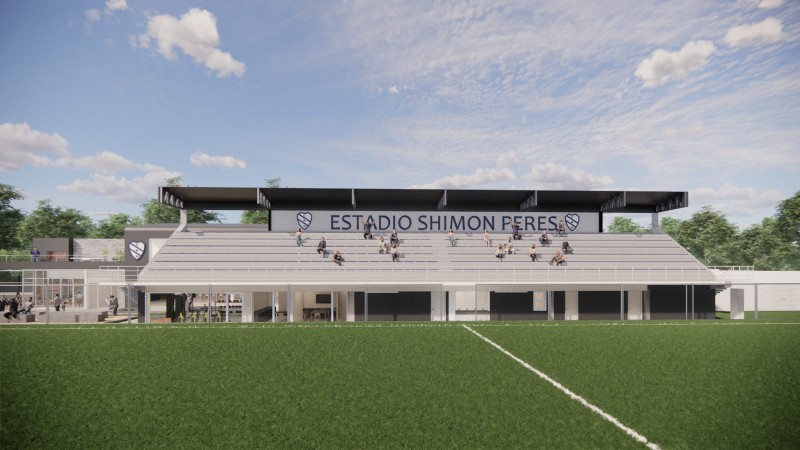
The Board of Directors and the Football Committee are driving a new transformation centered on the Shimon Peres Stadium: The Hacoaj Camp, one of the most significant infrastructure projects currently being developed by the Club.
Its concept extends beyond football. It will serve as a high-standard facility for the athletes representing Hacoaj while also allowing the Club to host national and international delegations, thereby strengthening its capacity to serve as a venue for competitions, sporting events, and community experiences.
The project incorporates modern design, accessibility, and gender-inclusive standards, featuring spaces suitable for athletes with disabilities as well as for mixed-gender teams and officiating crews.
Completion of the Hacoaj Camp is scheduled for March 2027. The complex will include accommodation for 34 people, renovations to existing bathrooms and rooms, private bathrooms for coaches, and a new second floor featuring bedrooms, a living area, and a game room, among other amenities.
A balcony with a direct view of the Shimon Peres Stadium will also be built, integrating the accommodation area with the project's sporting heart. The project also includes a room for the coaching staff, a dedicated equipment room, a rehabilitation gym, a home locker room for 20 players and staff, contrast therapy plunge pools, custom-designed furniture for pre- and post-match use, a referee locker room designed to accommodate mixed-gender officiating crews, and a larger visiting team locker room.
In addition, the public restrooms are being renovated, and a dedicated, accessible restroom for people with disabilities is being added.
Infrastructure, training, and competition are all part of a single plan: to create better conditions for Hacoaj’s soccer program to continue growing.
A HISTORY THAT BUILT THE PRESENT
The current project does not start from scratch. It builds upon generations of players, coaches, officials, and families who made soccer a central activity at Hacoaj and created a history that allows for new challenges to be envisioned today.
In 1976, Hacoaj played in the Argentine Football Union’s top division for the first time, finishing in 16th place. Alberto Brailovsky played on that team. In that league, the team—coached by Marcelo Ofman—won five consecutive championships. It was also a consistent contender in Faccma tournaments.
The team also won multiple championships in the Liga Escobarense; until 2024, it held the record among clubs from that league for advancing the furthest in an AFA competition.
WOMEN'S SOCCER TOO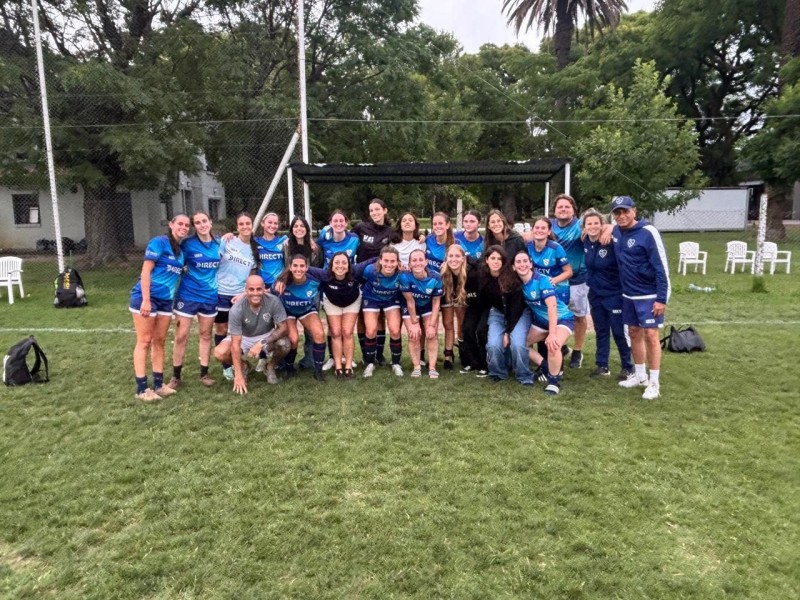
The women's division was added to Hacoaj's soccer program seven years ago. Since then, it has undergone a process of sustained growth, increasing participation and creating new opportunities for training and competition. Following the pandemic, the club decided to focus on youth development for the U-12, U-14, and U-16 age groups, ultimately winning the overall championship in LUEFI (Unified League of Children's Football Schools)—one of the few leagues playing 11-a-side soccer outside the AFA system. This effort paid off, with the first team winning the league's cup competition.
Currently, there is an 11-a-side first team competing in LUEFI and a 7-a-side team. There is also a youth setup comprising U-17, U-14, U-12, and U-10 categories; the latter does not play in official league matches but does participate in monthly friendly games.
The goal is also for Hacoaj to be represented in AFA women's soccer. And just as in the men's game, there have already been players from the women's side who have moved on to play elsewhere: Sol Eddi, Pipa Campanera, Zahira Cohen, Mika Rabinovich, and Milena Tolchinsky.
The men's and women's programs are part of a shared vision: to grow Hacoaj football from the grassroots level up, create opportunities for players of both genders, and build—season after season—an increasingly competitive project.
Because reaching new heights is a dream. And above all, it is a goal built day by day.
Photos: Comunicación Hacoaj
